Search This Blog

Showing posts with label elizabeth. Show all posts

Ross and Demelza - The Myth of An 'Impossible' Or 'Impractical' Separation

Demelza Poldark looking sad with her back to Ross Poldark who is looking at her in anguish a rip torn paper effect separate them

"But I could not come too you again-break up everyone's life afresh." 
Ross to Elizabeth three years after 'The May Incident'  'The Four Swans' 

After that 'May Incident' in 93 Ross did not go to see Elizabeth and only met with her by chance some three years later 
at the Sawle Church Graveyard in 1796. Elizabeth, who after wishing him dead in her thoughts and displaying a visible anger of him, had eventually calmed down when she suggested to him that he may have regretted what he done to her. As quoted above from this scene in the sixth book 'The Four Swans', Ross told Elizabeth in reply that he "could not" come to her and break up everyone's lives. From this, one might think this this suggested that part of Ross may have actually wanted to go to Elizabeth and therefore to break up his life with Demelza and her life with George too. So this scene in the book and after Ross's return to Nampara invites a consideration of Ross separating with Demelza and this is what this post will explore. 

From an emotional point of view previous posts 'A Discovery of Preference' and 'Reassurances and Reaffirmations of First Choice' both actually explore the question of whether it was a matter of the head rather than the heart that caused Ross to stay with Demelza, instead of separating to be with ElizabethThey do both document that this was far from the case, with the first of those posts focusing on Ross's journey of discovery that he did not have a 'real and true love' for Elizabeth. The second focused on how, along with the author's verification, Ross was able to convey with conviction to Demelza that his real wish and his heart's desire was to be and stay with her. So in the end this choice of Ross's for Demelza, instead of Elizabeth, was made irrespective of practicalities because it was based on feeling rather than obligation or rather than just having to regretfully take what was left for him. 

It seems that Ross's words to Elizabeth at the Church Graveyard were phased deceptively 
in a spirit of peace and diplomacy. No doubt this was so that Elizabeth could feel comforted that he may have wanted to come to her. In light of her anger and Ross's great wrong to her it was fair that he take that approach rather than for Ross to have offended Elizabeth once again by implying that his offence was all for nothing and that she had experienced his attack on her when leaving Demelza never was the merest consideration for him. Nevertheless this post explores whether logistically Ross could have separated with Demelza for Elizabeth if he really wanted to. It will serve to address a questionable assumption that either way Ross had no choice but to stay with Demelza regardless of his wishes. This post will make significant historical references to personalities of the time and their separation scenarios in order to provide context of the times. So the focus here will be on the practical issues around processes and societal attitude to enable Ross and Demelza to separate, while the post to follow that called 'Ross and Demelza- Falling Into Separation' and 'Demelza's Three Offers To Leave Ross- Ross's Resistance' will focus on the emotional narrative of how they as an estranged couple fell into a state of separation with Demelza in particular leading the way with this against Ross's resistance. Thirdly in this quartet of essays 'Demelza’s Hall Pass' will similarly to this post cover the practicalities and societal attitude should Ross have wanted Elizabeth as his mistress.  

Elizabeth: Envy Of The New 'Great Lady' -Demelza Pt 4 (10 Truths On Elizabeth's Astonishments And Humiliations)

Demelza Poldark is at a ball dressed glamorously in a gold dress coming down the stairs as Elizabeth looks sad and jealous watching her

'She was a beautiful, rather over-reserved, disappointed young woman. She was also jealous of the blossoming Demelza though she tried to fight against it.'
Narrative of Elizabeth's thoughts at the Truro Ball 1789 Demelza  'Demelza'  first edition (Internal Book 1 Chpt 6)

Following on from the last post 'Elizabeth: Observing The Prize Wife -Demelza', this post is now the fourth in the series of essays covering the theme of Elizabeth's astonishments and humiliations in relation to her interaction with the Ross and Demelza love story. The scenes and event in focus for this post centres around a grand ball that Elizabeth attended in April 1789. Demelza also attended this, and in fact this was when she was essentially introduced by Ross to his gentry society. Therefore this was the occasion where Demelza essentially 'came out' (into society) for her first ball. Like her coming out as Ross's wife to his family (as covered in the last post), Demelza was more than a tremendous success at the ball too. It is from this that Elizabeth would experience astonishment and humiliation by way of inadequacy and a sense of failure in comparison against Demelza.

Elizabeth : Observing The New Prize Wife - Demelza Pt 3 (10 Truths On Elizabeth's Astonishments and Humiliations )

blog banner of Ross Poldark smiling at Demelza who side profile is smiling with her head down while Elizabeth is behind looking sad at their love

Humiliation: To reduce (someone) to a lower position in one's own eyes or others' eyes / to make (someone) ashamed or embarrassed.
As this post covers Demelza's formal introduction to the Trenwith Poldarks and their friends 
as Ross's wife in December 1787this is the third one in the series of essays exploring the theme of astonishment and humiliation that Elizabeth once introduced as a cloud over her life. The last two posts in the series were 'Bud On The Horizon' and 'Demelza-Elizabeth's Powerful Obstacle'. They covered the first two scenes which seem to have contributed to this theme against Elizabeth. As set out in that first and lead post in this series, and in accordance with the definition, humiliation for Elizabeth's theme would involve narrative and story development that seemed to lower her position to the reader. For instance, through her position to Ross being knocked as the woman that was 'The prize' above most other women, including Demelza. Indeed as Demelza was an unexpected roaring success for this Christmas event Elizabeth had a front row seat in observing Demelza assert her position as as a 'prize' wife for Ross. This is just like how Elizabeth had previously been thought of as when marrying Francis. As if recognising her own reduced and lower position under Demelza just as if in her shadow, Elizabeth would have an emotional reaction to this. This would include an outburst and a plan to redress this which would reveal the extent of Elizabeth's displacement and bitterness

Demelza- Elizabeth's Powerful Obstacle (Pt2 10 Truths On Elizabeth's Astonishments and Humiliations )


'....and they were both aware, while not knowing that the other was aware, that the reconciliation had come too later to count for what it might.'
Winston Graham's narrative as Elizabeth ends her visit to Ross at Nampara ( ‘Ross Poldark’  internal Book 2 Chapter 8 )  

This is a second post continuing on from the lead one titled '10 Truths On Elizabeth's Astonishments and humiliations Pt1 Bud On The Horizon'. That was an introduction to the exploration of this theme (of astonishments and humiliations) as one that Winston Graham imposed on Elizabeth and which was a theme that ran through all aspects of her life. However, in this series of posts it is explored in respect of Elizabeth's interactions within the Ross and Demelza love story. That first and introductory post explored specifically what the theme was about and why Winston Graham may have chosen to direct it so clearly, repeatedly and consistently against Elizabeth within her life experiences generally. It ended off with the first of ten significant scenes which contributed to this narrative against Elizabeth where in that particular scene her lack of influence on Ross to cause him, in respect of the newly on the scene Demelza, to "..send her home.." and also her behaviour which caused Ross to end up fighting with extra strength and passion to do the very opposite, is a bit of an ironic jibe at Elizabeth. That was only as the narrative was kicking  off at that early stage. Of course it all meant that Demelza was somewhat of a bud on the horizon who from that, and given her humble beginnings, would later blossom and become a powerful and successful obstacle to Elizabeth in her quest for Ross's romantic interest and in her quest to have the greater priority and influence over Ross than Demelza did.

This post now covers the second key scene for this theme of Elizabeth’s and the period after the two year time jump in the first book when Demelza had come of age. This is where Elizabeth would experience that Demelza as that bud that was previously just on the horizon, was now in her clear view and had blossomed enough to become an obstacle to her intentions with Ross following the collapse of her marriage to Francis. The scene in focus is the iconic 'Bluebell Scene'. It is actually a landmark milestone in Graham's narrative of astonishment and humiliation for Elizabeth because as well as a significant turning point for Ross and Demelza it is the first shock for Elizabeth that she felt in the moment with this narrative. This was to the extent that it caused her to literally flee the scene. For this reason and because of the many issues it throws up, it is addressed here in this post at some great length while the other key scenes for her theme will be addressed in later posts.

10 Truths On Elizabeth's Astonishments and Humiliations Pt1 (Demelza-Bud on the Horizon)

"Is it such an astonishment that a woman who changed her mind could change it twice?...Well, yes, perhaps it is, for it has always been an astonishment and a humiliation to me."
Elizabeth to Ross ‘Warleggan’ (Internal Book 1 Chapter 3)

This essay explores the theme of Elizabeth's 'astonishment' and 'humiliation' within her interaction with the Ross and Demelza love story. This follows on from the last post 
‘A False Impression?: Elizabeth’s Impulsive And Romantic Disclosure To Ross', where Elizabeth introduced the idea of this theme applying to her. As a brief recap that post focused on the scene in ‘Warleggan’ at the Trevaunance party in May 1792 when Elizabeth Poldark told Ross Poldark that some years ago, at a time that she did not clarify, she had discovered that she loved him ‘better’ than Francis. She went on to say that her change of mind in favour of him “…has always been an astonishment and a humiliation to me.” That last post explored this and found that Graham’s narrative elsewhere contradicted Elizabeth’s disclosure and suggested that in Elizabeth's vagueness she had given Ross a false impression. However that does not mean that she did not feel these emotions for other reasons as part of a theme against her.

A False Impression? -Elizabeth's Impulsive And Romantic Disclosure To Ross

Elizabeth sitting next to Ross confessing that she loves him with title 'A False Impression?

In a perfectly cool, young voice she said "I never really believed you were dead. I thought I loved francis better...And then I discovered my mistake.”

Elizabeth to Ross ‘Warleggan’ (Internal book 1 Chapter 3)

In 'Warleggan’ Elizabeth suggested to Ross Poldark at a party that long ago she had realised that she loved him 'better' than her husband Francis Poldark. As with her quote above, she referred to herself as having discovered that she had made a 'mistake'. Elizabeth also also went on to give Ross the impression that this self discovery of hers had been an ongoing  'astonishment' and 'humiliation' to her afterwards. However it was nine years beforehand, as Ross had recalled, where Elizabeth had told him "I don't love you." Winston Graham had shared in real time that on that Easter Wednesday of 1784 Elizabeth also told Ross "...Ross, ours was a boy-and-girl attachment. I was very fond of you......But you went away and I met Francis and with Francis it was different. I loved him..." This means that her disclosure at the Warleggan party was a reversal of what she had told Ross initially, and on the face of it this surprising disclosure looked like quite a personal, impulsive and self deprecating revelation from Elizabeth. This is especially since she was typically quite a guarded character. However, aside from the reworkings of her character in the most recent adaptation of Poldark, based on the original story in the books, the question of Elizabeth loving or not loving Ross has never been explicit and without question, in the way that the feeling of love has been between other characters in the story. This post will therefore explore whether Elizabeth's disclosure to Ross was a truthful one or whether he was given a false impression. 

A Judgment on Rape (A Case of Rape or not for Ross Poldark)

Ross Poldark corners Elizabeth and they are face to face before the rape scene
⚠ Content and moving images reference sexual violence.
 

On 9th May 1793 in the fourth book 'Warleggan' (Internal Book 3 Chapter 5), an incident between Ross Poldark and Elizabeth would end up being a significant life changing event in their lives and also in the lives of their respective spouses; Demelza, and Spouse-to-be George Warleggan. As covered in the previous essay 'Ross Poldark's Fall From Grace (A Thin Line Between Lust And Hate For Elizabeth), during the throws of an argument about Elizabeth's decision to marry George, Ross ignored Elizabeth's protests at his anger driven sexual advances and carried her to the bed. Graham did not write what happened thereafter. This means that though the reader is made aware that sexual intercourse did take place, with Winston's perceived silence on whether this was consensual or otherwise a rape, this has since been a controversial topic and much questioned incident in the saga. 

Ross Poldark pushes Elizabeth to the bed the it cuts to him leaving and rushing away in the morning
Setting aside the natural desire not to potentially think ill of the romantic hero, Ross Poldark, this post will serve as a judgment with a finding on that key question: 'Did Ross Poldark rape Elizabeth on the night of the ninth of May 1793?' To come to a finding which is non emotive and objective, the assessment for this will be split in four parts. Part 1 covers the  criteria and understanding of rape by Winston Graham and Ross. Part 2 and 3 cover respectively the evidence from Ross as the accused in this case, and from Elizabeth as the potential victim. This will be through their thoughts, statements and actions, as recorded in the relevant books of the saga. To conclude, part 4 will at the last set this against the evidence of which there is some from the two impartial witnesses being Winston Graham, the impartial narrator and Winston Graham, the author

Francis And Elizabeth: Reformed Gracious Husband, Content Wife


“Elizabeth blooms like a painting; she has had a better year... She doesn't love Francis, but she's more content.”
Demezla’s observation and thoughts on Elizabeth in ’Jeremy Poldark’ (internal book 2 Chapter 14)

Whilst posts such as ‘A Charming and Generous Heart' indicate that at his core Francis was a man with a good heart, he did have his vices which went against him. The last two blogs on his marriage depict him as a husband filled with promise since it was early on that Winston Graham first narrated his credentials of being handsome, charming and wealthy. Added to that he was besotted with Elizabeth as a fiancé and presented as a good and loving husband in the first year of marriage. However the middle period of the marriage draws Francis criticism as a husband until, as covered in this post, and despite the lack of love from Elizabeth, he seemed to turn this around and present as quite the reformed and gracious husband to her in the end. In this re-emergence of Francis as a decent husband he should be recognised for at least bringing Elizabeth back to a place of 'contentment' in those last years of the marriage, just as Demelza observed (and is quoted above). This post confirms and explores how Francis managed to do this. 

A Kinder Husband And Wife Relationship


 'The relationship between them had been kinder these last two years,...'
Narrative in 'Warleggan' (internal book 1 Chapter 2)

If there is any question about a genuine and positive change in the marriage of Francis and Elizabeth in those last couple of years before Francis passed away, then Winston Graham confirmed this in the narration. Quite significantly, after Francis’s suicide attempt, Graham reported that although never warm 'The relationship between them had been kinder these last two years,...' ('Warleggan' Book 1  Chapter 2)  That serves as confirmation that things had moved on with improvement from earlier in the story when things went wrong from a year into the marriage. On that day of Geoffrey Charles's Christening they had had a marriage altering argument which saw their marriage disintegrate and after the two year time jump in that first book readers learnt through Elizabeth's visit to Nampara and Verity's account to Ross, that they had not got on well since Geoffrey Charles was born. However, the key to the kinder relationship between Francis and Elizabeth points to a change and a reformation with Francis and not Elizabeth.

Elizabeth And The Analogy Of The Key (To Unlock Ross's Love And Desire)

Ross Poldark and Elizabeth dancing

This post is a follow up to the previous one titled 'That Mysterious Unlocking Key-Demelza' which is inspired and framed around a particular passage in the second book 'Demelza'. This is where Graham wrote Ross's thoughts of gratitude for having Demelza as his wife. He was thinking of how she had a ‘mysterious way’ about her that like a key unlocked his attention and desire and love. That post looked at where the mystery arose from and how it was a unique blend of personality traits which made Demelza 'that key' for Ross. It also considered how Winston Graham set Demelza apart from other women as being able to fully command Ross's heart in this way. For instance, it addressed that, though Ross was quite taken by women such as Caroline Enys and Harriet Warleggan, they still did not have the elements to be ‘that key’ for him. While that previous post also hinted at Elizabeth’s potential to be an 'unlocking key' for Ross, it was promised that this should be explored more thoroughly. Therefore, this is the purpose of this post. However, this will say that despite Ross's self confessed ten year devotion for her, Elizabeth also did not have this ability of Demelza’s to be an 'unlocking key' for Ross in the long term and as the woman she had become.

Another Unlocking Key: Elizabeth?


'He was struck by the mystery of her personality ...that this hair and head and person of the young woman below it....meant more to him than any other because it made up in some mysterious way just that key which unlocked his attention and desire and love."
Narration of Ross's thoughts on Demelza 'Demelza' (internal book 1 chapter 10)


This is ‘the key passage’ that this post and the last one is based around. It is from chapter 10 of the first internal book of 'Demelza'. This invokes the imagery of a key that unlocks something special, as it confirmed that Demelza did this for Ross. However, since many keys are not designed to open one lock, the imagery of a key is also synonymous with being ‘The One’. The emphasis being on the word 'one' in 'one key'. So that is 'one key' out of many that is unique, as the key serves as 'the only key' that can open a particular padlock, front door, treasure chest or in this case Ross’s full heart and soul. That 'one' key is designed to be perfectly in tune and fitted to that one lock. Ross’s lock. 

Poldark True Story Vs Adaption Fiction (Pt3 -Did Ross Settle For Second Best Choosing Demelza Over Elizabeth?)

Blended image of Poldark Adaption fiction with Ross Poldark standing in Trenwith with Elizabeth and Valentine Warleggan and a blend of a stern faced Demelza Poldark looking in their direction.

There is no requirement that an adaption of a book to a movie or to a series must be 100% faithful to that book. In the case of the true story of Poldark written by Winston Graham, it is indeed noticeable that 
a different slant was given to the love story of Ross and Demelza and to Elizabeth's position within that in the most recent television adaption of Poldark (which commenced in 2015 and stopped in 2019). This was even after the climax where Ross quite unromantically took Elizabeth to bed by force. But as this series of posts considers whether Ross Poldark 'settled' for Demelza, it should be noted that in contrast to the adaption fiction, Winston Graham was clear in clarifying a narrative that can be distinguished from the narrative that was taken up in the latest adaption. This is his statement in his capacity as the story’s author that it was this experience, 'That May Incident' with Elizabeth that caused Ross to 'discover' that it was Demelza that he 'really' loved. (See image below: Article  Winston Graham Goes A Second Round, 'Opelousas- Daily World' newspaper dated 25th June 1978)  The differing stance of the adaption, how this was done and the impact this has on the perception of whether Ross settled for less with Demelza, is the focus of this particular post.

A Subliminal Narrative Revision


Elizabeth gives Ross Poldark as cold stare as she turns and walks into Trenwith with George Warleggan
Adaption fiction not based on the true Poldark Story
The post to follow this one will focus on Ross subconsciously feeling that Demelza was the woman he wanted and loved more than any other woman. Hence more than Elizabeth! This is because 
there are bits of the story which serve as a foretelling that Ross would always choose Demelza over Elizabeth. This is because he loved her more authentically. However the discussion here is on how the Poldark series adaption did not necessarily support those foretellings in the books, but instead may have purposefully or inadvertently steered some viewers to think that, save for the unfinished business of Valentine, that there was also unfinished business in Ross's mind of an ongoing and romantic longing for Elizabeth after 'That May Incident'. This then can feed the idea for those viewers that contrary to Winston Graham’s statement there was indeed a loss to Ross in all this and that in his mind Demelza was and still remained his second best love even after this incident. 

The Good Husband In The Beginning Pt4 (The Real Francis Poldark)

Francis Poldark Good Husband in the beginning blog banner


To know the real Francis requires an understanding of both the good and bad aspects of his character and therefore this includes recognising the side of him that was a good husband as well as the times where he seemed to fail as a husband. Indeed Francis may often be wrongly given the sole blame for his and Elizabeth's unhappy years of marriage. The second post in 'The Real Francis Poldark' series called 'A bad and Unfaithful Husband' did document Francis's bad husbandry of Elizabeth during the middle period of this marriage where he wallowed in disappointment of it. Because of this disappointment he leant more excessively into his vices and into unfaithfulness too. No doubt for a period this established a kind of catch 22 scenario of ensuring a stalemate and no positive progress in the marriage for a while. However the blame is not necessarily one sided and therefore not solely resting on Francis's shoulders. In fact it is arguable that outside of the period of disillusionment Francis was probably more invested and put in more effort than Elizabeth did for the chance of an amicable married life. 


In the original story of the books not only is there narrative of Francis as set out in t
he last post in this series, whereby he was 'The Loving And Besotted Fiancé', but as was even recognised by Elizabeth there is also narrative of Francis as a good and loving husband in the first year of his marriage and a good and amiable one in the last couple years of it too. 

This post looks at the initial period at the start of Francis and Elizabeth's marriage. And so this is before that dark middle period where it deteriorated. Whilst it was in this first year where Francis showed promise as a 'good husband' and that because of this he was appealing to Elizabeth, a follow up post called 'The Good Husband In The End' will explore how after the deterioration and the unhappy times that came with that middle period of their marriage, Francis did remerge once again in the final years of the marriage to fulfil his initial promise. 

The Loving And Besotted Fiancé Pt3 (The Real Francis Poldark)


The second post (being the last one in this series) that addressed 'The Real Francis Poldark' explored Francis's position in the story as a bad and unfaithful husband but essentially how this was for a time and was rooted in his disappointment of expectation in his marriage with Elizabeth. In a sense it was this disappointment that fed most of Francis's vices which surfaced in the middle of his story arc. However, it would be wrong to completely write off Francis as a bad romantic partner and husband for Elizabeth throughout his courtship and marriage with her. W
hilst the saga narrative of Francis seems to lull the reader to give him this general unfavourable label, as shown in that last post, below the surface there is more to this and there were certainly periods where he had the makings of a good husband for Elizabeth and did actually demonstrate this. Since the previous posts have focused on his failings, this post focuses on the positive indications of Francis before his marriage and as a fiancé. The next will focus on the same, but during the marriage. Therefore this would be in the early period of  the marriage and some years before his death brought the marriage to an end. 

It Started With Infatuation And Love 


There is no doubt that to begin with Winston Graham wrote Francis as a character that was initially in love with Elizabeth both before and after 
he was engaged to her. Readers can assume that despite the more functional attitude toward marriage of that day, that it is more than likely that Francis entered into marriage with Elizabeth in good faith and with the intent to be a 'good husband'. That intention therefore included to be faithful and devoted to her, and naturally he wished to have a happy married life where she would equally be loving and faithful to him too. That would include being faithful and loving to him in spirit as well as in deed. Readers eventually find that in respect of Elizabeth she failed to do this in spirit just as much as he had failed as a consequence to do this in deed. However before Elizabeth became 'the loved but the unloving, the Galatea who never woke..' (as Dwight had deduced from a suicidal Francis in the third book

A Bad And Unfaithful Husband? (Pt 2 The Real Francis Poldark).


The first suggestion of Francis's cheating was in December 1787 when Elizabeth expressed her concern to Ross that Francis was going with another woman. This was some significant time after their marriage seemed to hit the rocks in late 1784. Graham did not provide the detail in between. Although the storyline of Francis cheating is not fully fleshed out by Graham in the books, it is however a story line which many define and judge his character by. Francis's infidelity can overshadow his whole story arc in the saga or at least the perception of him as a husband. Therefore he is often labelled a 'bad husband' as well as an 'unfaithful' one. This is irrespective of anything else, the changes he later made, how his story ended and whether Elizabeth herself was a good and faithful wife to him. The question here is whether that is entirely fair and whether the many factors to be considered when labelling Francis as a 'bad husband' make this a black and white matter.


Francis's infidelity was with the harlot 
that Ross had also slept with one night early on in the first book. This was Margaret, also known as Margaret Cartland and then Margaret Vosper. Whilst most readers will automatically (and rightly so) write this behaviour of Francis off as 'unforgivable', often the judgement on him lies simply in the fact that he did cheat but without also exploring much of the reason why he did this and what this says about 'the real Francis Poldark'. So in exploring this concept of the real Francis over a series of posts, that idea and Francis's general persona as a 'bad husband' is the focus for this post. The next post on this series 'Francis: A Good Husband in the Beginning' and 'Francis and Elizabeth: Reformed Gracious Husband, Content Wife'  will explore the other side and perhaps highlight the choice to define him as a 'bad husband' might be rooted in the hanging on to the middle part of his story, rather than the end of it which could be thought of as redeeming.

Absence Of A Devastated Heart- Elizabeth Compared (Pt2 A Lacking Instinct Of Love For Ross Poldark)


The previous and part one of this post titled 'The Distant And Cheating Heart Of Elizabeth' covers Elizabeth's loving instinct when she was separated from Ross before the written story began. They were each other's first love and they had promised to marry when he returned to her from war. What was apparent was that during this separation from Ross, Elizabeth's loving instinct was lacking. Rather than absence making her heart grow fonder and her faithfully waiting for Ross, the opposite happened. Instead, she didn't wait for Ross and she formed a new attachment with his cousin, Francis Poldark. As narrated by Graham in the first edition of the first book, as well as Ross realising through her letters to him that Elizabeth had felt a 'slackening' interest in him while he was away, just as she later told him several times, their love to her was just a 'childish' thing and their romance had just been a 'boy and girl attachment'. This in a sense explains the lack of a loving impulse by her towards Ross at that point in the story, and most likely towards him thereafter. 

Theme of The Separated Lovers


What is also apparent is that the separated lover's theme was one that Graham replicated not just in Elizabeth and Ross's story but several times in his saga in the love stories of other characters. These were characters whose love for their suitor was written so that this love would never be in question to the reader. It so happened that in those stories there were elements of devastation that both of the lovers suffered as a result of their separation from each other. Another manifestation of the loving instinct for these couples was that during the separations they pined for each other, were concerned for the other and often even deteriorated in looks, health and mental well being until they were reunited with each other. It is clear to conclude that in this separated lover's theme and storyline Graham singled Elizabeth out as not suffering from a distraught and devastated heart in Ross's absence, and on his return. This supports the suspicion that equally, unlike the others where they loved and were moved by a feeling of love, Elizabeth did not truly love Ross in that way and therefore was not moved by this level of feeling either.


Elizabeth's Loving Instinct Compared. - A Different Mindset


Comparison can be a great teacher of a 'likely truth' as it is often the case that a significance can be found in commonality or differentiation. Therefore in this post, concepts and themes in Elizabeth's actions and thoughts on Ross (as set out in the previous post), will be set against those in the love stories of characters such as Verity, Caroline, Morwenna, Drake, Clowance and Jeremy. This is because they all had similar dilemmas to Elizabeth in their love stories but she acted differently to them. It's a fair consideration that she went against the grain because her feeling and the impulse this would stimulate was not the same as with the other characters and did not even compare really. 

Although comparisons with other characters might not be a perfect and definitive indication of a fact or this 'likely truth',  as referred above, it can certainly be a revealing and worthy consideration if the outcome consistently goes so far against the norm for how the loving instinct would normally manifest itself. The fact that in respect of Ross, Elizabeth consistently failed to act as if she followed the natural impulse of love or had thoughts akin to this, strongly suggests that this is because she had a completely different mindset and feeling from the other male and female characters that did truly love. 

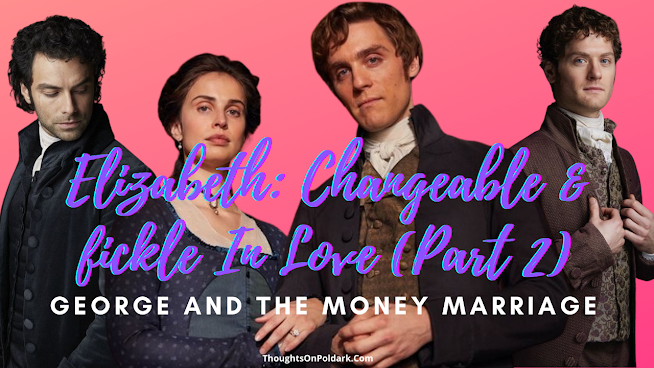
Poldark: Elizabeth - George And The Money Marriage Pt2 (Changeable And Fickle In Love)


Elizabeth and George Warleggan stand arm in arm with Ross and Francis Poldark standing either side

In the previous post, which is the part one of this topic on the changeable and fickle nature of Elizabeth's love, her changes of mind regarding her love interests Ross and Francis were highlighted as a strong theme in Elizabeth's story and character. To recap a little, rather than blow up like a burning fire greater and stronger than ever before, Elizabeth's love for Ross Poldark diminished in his absence. Then, after his return she claimed by her words that her feelings for him changed again on another two separate occasions. These will be explored more fully in the post 'Three Changes Of Mind Loving Ross Poldark'. 

As for Francis, Elizabeth's change of heart came about with the birth of their first child who Elizabeth directed all her love to instead. Describing Geoffrey Charles (and not Ross) as Francis's 'more powerful rival' Graham narrated that for Elizabeth motherhood was an 'all absorbing task' where '...ordinary duties became void.' Also, as their financial situation became dire Elizabeth lacked motivation to work on her marriage even after Francis had changed his more reckless ways, was more positively focused and also when Graham narrated that their relationship had become kinder. As Elizabeth explained to Morwenna, by that time she was just 'tolerating' him.  

In this post Elizabeth's change of mind concerning George is the focus. In this there is the idea that contrary to her lack of motivation to save her marriage with Francis, her willingness to do this with George in many ways only highlights a fickleness in terms of love not being the driving force to this. Indeed the fickleness that underpinned her relationship with George and the reasons she formed a relationship with him in the first place will also be in focus.

George: The One Who Didn't Stand a Chance Until She Needed Him 

Elizabeth Poldark talking with George Warleggan at a party
Although Elizabeth had not loved George, there was still an element of a change in her mind that she had regarding her relationship with him too. When Ross in the sixth book 'The Four Swans', met Elizabeth at the church graveyard and told her that "He (George) has wanted you since he first saw you....But I never dreamed he had a chance." Elizabeth who was then married to George answered "Neither did I." 

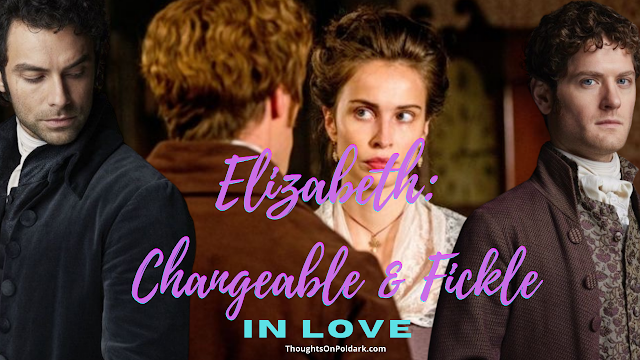
Poldark: Elizabeth -Changeable And Fickle in Love (Part 1)


"Not a changeable-minded woman! Was that what George thought her? ........, all that had happened was a result of it."
Thoughts of Elizabeth ('Warleggan' Book 3 Chapter 10)

Throughout the Poldark story Winston Graham continually developed the concept of Elizabeth as a woman who was more than susceptible to changing her mind. Though this concept is often identified as a feature of her relationship with Ross Poldark, when considering Elizabeth's changeableness in love, the astute reader will notice that in fact the concept of her 'changeableness' runs through all her love stories with the three men, Francis, George and Ross. Through them Elizabeth was presented as a character who on the particular matter of love and relationships was not particularly resolute and steadfast, but instead could change her mind according to her circumstances. In all this it appeared to be that there was a flighty and fickle nature to her love and loyalties.

This first post of two parts will explore Elizabeth's changeableness and fickleness in love with Ross and Francis, whilst the second will explore the same in regards to her relationship with George. However, whilst this post will touch on Ross, this will be quite lightly so as her change of mind with him will be dealt with in a more detailed step by step manner in the follow up post 'Elizabeth: Three Changes Of Mind Loving Ross Poldark'. 

Story of a Changeable Love From A Changeable Woman


Three Men- Three Changes Of Mind- Ross First


The story begins with the reader being informed that Elizabeth having loved Ross before he went to war, in his absence and before his return did 
change her mind about him for Francis instead. Elizabeth would herself explain to Ross that she did not 'keep the faith' with him, did not love him and that she found she fell in love with Francis while he was away. Many more years later in the fourth book 'Warleggan' Elizabeth would confirm this first change of mind against him had indeed been the case but also express that she had later changed her mind back to thinking she loved him again. So she claimed that she felt she had made a 'mistake’ that first time round. 

Elizabeth was not at all consistent in her position and feelings for Ross. She changed her mind and her feelings for him a third time as she eventually seemed to move from what she may have thought was love (or at least fondness and affection), to feelings of hatred and antipathy. This was before seeming at peace with him from a distance but not necessarily in love with him. 

Ross :The Fall Out Of Love- A Reason of Substance Or Fickleness?


In briefly addressing Elizabeth's first change of mind against loving Ross, there is a strong sense that this was due to his absence at war not making her heart grow fonder but instead more distant. She went astray with a better offer from the charming, present and wealthy (at the time) Francis. The impression is that she had a lack of true commitment and a flightiness in her love that some of the other female characters in the story did not have. 

Poldark: Nine Lives Nine Deaths


"You see, in a play one knows virtue is going to be triumphant..." 
Caroline Enys nee' Penvenen (Warleggan)


Except for the third there is at least one 
death in every book of the earlier set of seven books in the Poldark saga
. In 'The Angry Tide' there are as many as five deaths including Sarah Enys, Mr Nathaniel Pearce, 
Reverend Osbourne Whitworth, Monk Adderly and Elizabeth Warleggan. So death is definitely a prominent feature of the Poldark story across all the books. 

Winston Graham wrote some very compelling and vivid passages for many of the death scenes in the story. Very often they were interwoven with themes, metaphors and concepts that tied together with others scattered across the story and which were particular to the character. This post is the prelude to a series of blogs which will look at 'The nine big deaths of Poldark'. Rather than the deaths written for the sub plots these will be the nine deaths that are of particular significance to the Ross and Demelza story in regards to their love and life story together. These include the deaths of Julia Poldark, Francis  Poldark, Agatha Poldark, Hugh Armitage, Monk Adderly, Elizabeth Warleggan, Jeremy Poldark, Stephen Carrington and the last death of the saga Valentine Warleggan. This series will look at the cause of each death and the themes that arise out of them together with the significance on the Ross and Demelza story. Also there can be no avoidance of the crucial question which is 'why?'.  'What was the reason for the death?'  This is in terms of the reason in respect of the story. That will be a matter that is of particular interest.
 

Two Reasons To Kill The Character 


Indeed when thinking of the death of a major character in a story this can 
naturally induce the thought of 'why did this character have to die?'  There can be sadness if it is a much loved character or a feeling of relief or satisfaction if the character was villainous, in some way unpleasant, an irritant or an agitator that frustrated the lives of others. Just like an antagonist would typically do. Of course, whatever the reader’s thoughts, the answer to why the character was made to die will always lie with the author. But even without an explicit running commentary from the author himself (in this case), it is not always so difficult to make an attempt to work out the author’s reasoning for writing a particular death in the story. This is even if they're reasons that the reader may not approve of or may actually resent. Winston Graham's style of writing aids this mission because it's often packed with such meaning which supports a particular and sometimes obvious theme for each of his characters and of the overall story. However, aside from this generally, and definitely, if taking a traditional literary approach, there are two main reasons for a character's death and the upcoming blog posts covering each of the nine character's death will look at what the author may have had in mind for each of the deaths he wrote. 

Elizabeth: A Competitive Spirit Against Demelza Poldark (A Love for Ross? Pt10)


Elizabeth wearing her special red dress for Ross in 'Demelza' and in 'Jeremy Poldark' was one of her early methods to entice and 'rebuild her ascendancy' over Ross. In the journey questioning her love or lack of love for him this post now covers her motives in this and if this was born out of love. A previous blog post 'Elizabeth: A Green-eyed Jealousy of Demelza Poldark' may relate closely as reference there is made to Elizabeth's confirmed feelings of jealousy towards Demelza. Graham narrated this was due to Demelza's 'success' and her 'blossoming'. However, jealousy and love do not necesarily go hand in hand so that jealousy does not necessarily prove the existence of a real love. This blog will consider another factor that might have been at play. A spirit of competition in Elizabeth. After so many years had passed did Elizabeth make her subtle moves to entice Ross because she was driven by an ardent and enduring love of him or instead because of a desire to beat Demelza and be the superior, most wanted and most admired one? 

Love On Hold?

Elizabeth visiting Ross poldark at nampara with a uneasy atmosphere
Turning up at Nampara four years after rejecting Ross and seeming to want something romantic from him might suggest Elizabeth was genuine as she had sought this before she even knew about Ross and Demelza. However on the other hand, as explored in the previous post 'Reaching out for Ross', if she was always and only ever motivated by a true love for Ross why did it take four years? And why coincidentally only when her marriage to Francis was crumbling or maybe over by then?

Here it is feasible to consider that Elizabeth falling out of love and happiness with Francis enhanced the appeal of Ross. Before then i
n the full edition of 'Ross Poldark' Graham narrated Elizabeth feeling 'life is good' with Francis and that her quarrel with Ross had 'healed'. Narrating her pity for Ross in his loneliness there was no feeling expressed of her self pity due to her loving Ross back and being denied of him. Instead Graham wrote in the full edition of 'Demelza' that this night had been the 'peak of her happiness'. Where her happiness with Francis went downhill her interest in Ross renewed itself and went up hill so that where for years she had not sought him out, then she suddenly did. Perhaps if this was not for love of him, it was for her to feel loved by someone else, if not her husband. 

Previous posts